06-09-2026 Q&A: Toolpath Ridges, Inlay Pressing Tips, and 3D Modeling Textures
Jun 09, 2026
Note: You must be a member of the Learn Your CNC Academy Community to watch this replay. Benefits include weekly Q&A Meetups, weekly project lessons, monthly CNC challenges, an active community of Vectric users, past replay lessons & project files, and so much more!

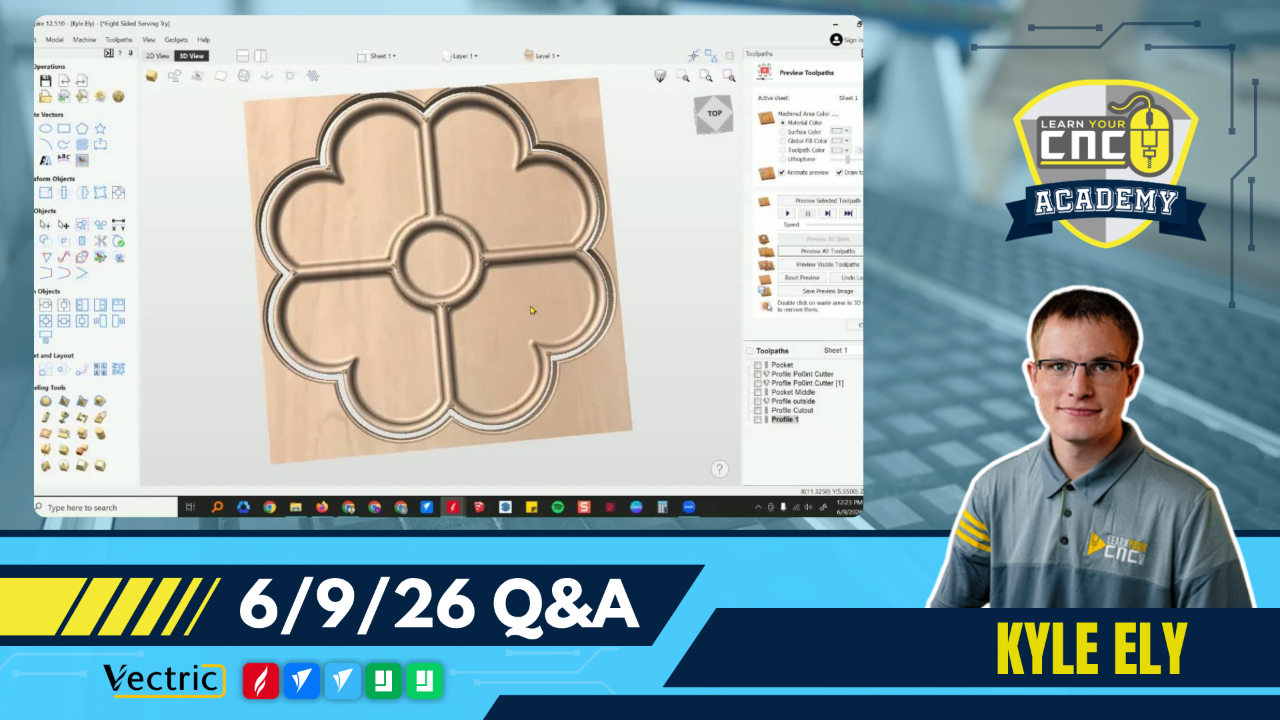
In this Q&A session, we covered a variety of CNC challenges from hardware setup to software design. We discussed how to eliminate vertical ridges on profile cuts, troubleshoot uneven V-carving depths, and clean up tight corners left by pointed roundover bits. The session also dove into best practices for clamping end-grain inlays, advanced 3D modeling using multiply combine modes for textured chamfers, and how to properly manage and copy material settings within the Vectric tool database.
Key Tips Learned in this Q&A:
-
Eliminating Ridges on Profile Cuts: To remove horizontal lines left by depth passes, use the "Do Separate Last Pass" option with a small final pass offset (e.g., .01 to .03 inches) . This enables the tool to cut flush to the vector line in a single, full-depth pass.
-
Troubleshooting V-Carve Depths: If a V-carve cuts deeper or shallower than the preview, the most likely culprit is an inaccurate Z-zero setup . Uneven material thickness or an unlevel spoilboard can also cause variations, which can be mitigated by surfacing the material or spoilboard first.
-
Cleaning Up Intersections: When a pointed roundover bit leaves excess material in tight inner corners, try drawing a small triangle vector over the corner . You can then pocket that area out with a small end mill before running the roundover toolpath.
-
Inlay Clamping Strategy: Avoid over-pressing end-grain inlays with a hydraulic press, as too much pressure can starve the joint of glue or crack the main board . Ensure the board is fully supported on the top and bottom, and consider breaking complex inlays into smaller, individual glue-up phases to maintain even pressure.
-
Multiply Combine Mode for Textures: In Aspire, you can blend a 3D texture (like bark) into a tapered chamfer without it protruding by creating a multiplier component . Setting the total height of this multiplier component to a factor of 1 applies the edge taper to the texture while keeping the center height unaffected.
-
Managing the Tool Database: If your tool database asks you to copy settings, it means the selected tool lacks saved data for your currently active machine and material combination . You can resolve this by copying the data from a previously setup material and then customizing the feeds and speeds to suit the new material type.
Questions Answered in this Q&A:
-
00:04:21 - David: How do I fix horizontal ridges on the sides of my project from my roughing bit passes?
-
00:08:22 - Bob: Why is my V-carving toolpath cutting deeper than what the software preview shows?
-
00:15:24 - Alan: How can I clean up leftover corner material when using a pointed roundover bit on an inside corner?
-
00:22:52 - Michael: What are the best practices and clamping durations for pressing large, complex end-grain inlays?
-
00:30:48 - Ruth: How do I model a textured inlay base with tapered edges in Aspire without the texture sticking out of the chamfer?
-
00:54:31 - Ruth: Why does my tool database prompt me to copy settings and only show material options I don't use?
-
01:21:23 - Terry: Can I make a straight rack gear with standard teeth using the gear gadget or other shape tools?
-
01:24:32 - Bob: What causes an error saying a toolpath doesn't exist when I try to select "Calculate All"?
Keywords:
profile toolpath, last pass offset, ridges, v-carving depth, z-zero, spoilboard, pointed roundover, end mill cleanup, inlay press, glue-up, aspire 3d modeling, multiply combine mode, texture clipping, tool database, feed and speeds, rack gear, recalculate toolpath error
Not a member of our Learn Your CNC Academy Community? Join over 1,500+ students today! Benefits include weekly Q&A Meetups, weekly project lessons, monthly CNC challenges, an active community of Vectric users, past replay lessons & project files, and so much more!